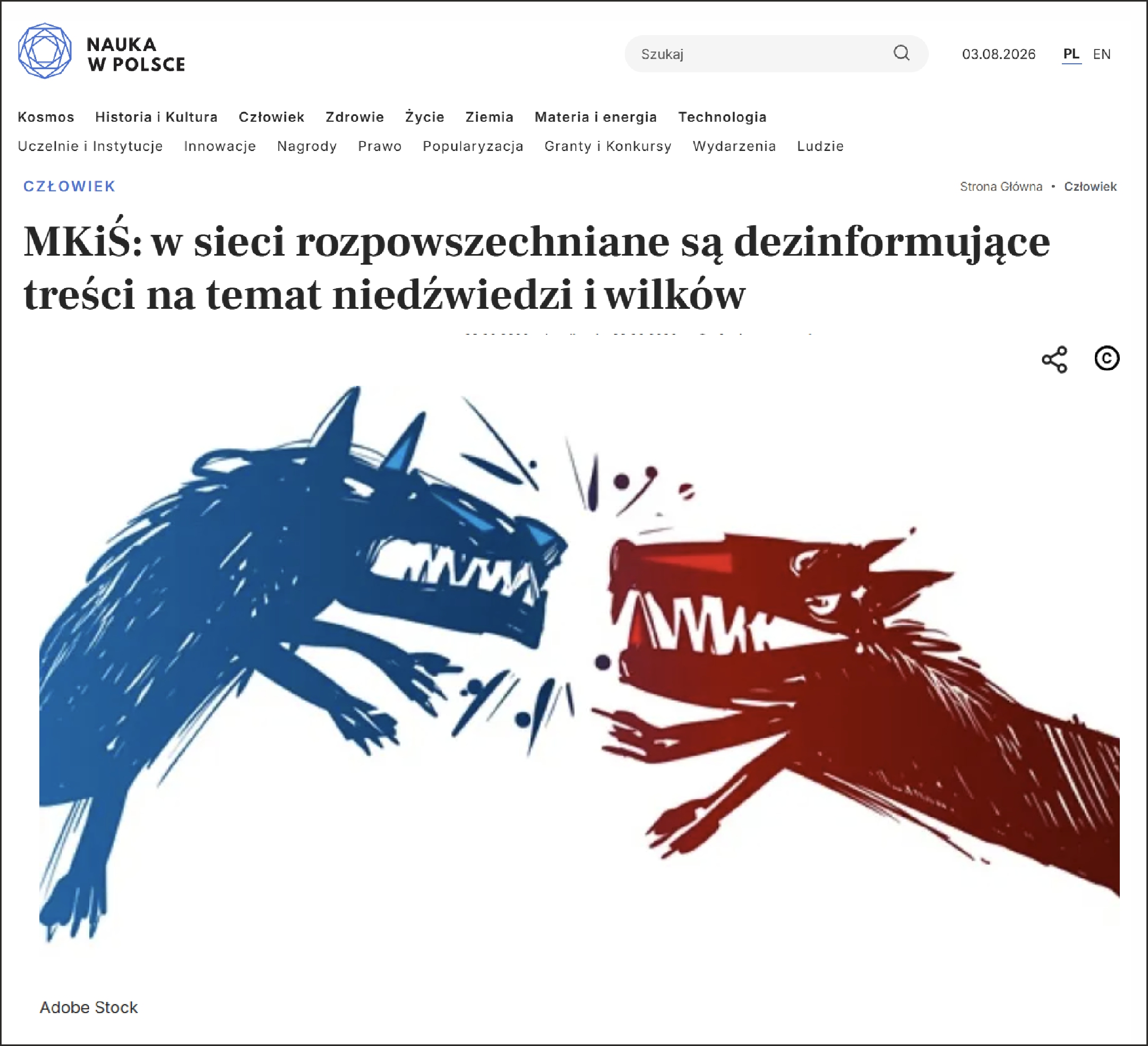
Disinformation in nature conservation is spreading at an alarming rate. Fabricated reports of wildlife attacks on people, sensational headlines, and hyper-realistic animals generated by artificial intelligence or manipulated by hand are becoming increasingly common.
We recently discussed the unprecedented scale of misinformation about wildlife—especially wolves and bears—during the DezinfoRadar panel organised by the Polish Ministry of Climate and Environment, with the participation of Dr Izabela Stachowicz*. You can read a summary of the discussion here:
[https://naukawpolsce.pl/aktualnosci/news%2C113686%2Cmkis-w-sieci-rozpowszechniane-sa-dezinformujace-tresci-na-temat-niedzwiedzi]
The internet is being flooded with fabricated videos whose sole purpose is to provoke unjustified fear and further polarise public opinion.
At the Mammal Research Institute PAS, we are not standing by: we actively respond to disinformation in the public sphere:
???? Providing scientific expertise: A good example is the widely publicised case of the alleged “puma” reported in Lower Silesia, which triggered local panic and mobilised emergency services. After analysing the available footage, Prof. Rafał Kowalczyk demonstrated that the animal shown in the videos was not a puma, but a domestic cat.
[https://www.rmf24.pl/regiony/wroclaw/news-to-nie-jest-puma-wazny-komunikat-po-analizie-nagran-z-dolneg,nIdn,1010466]
✉️ Calling for responsible reporting: Last year, at the initiative of Dr Michał Żmihorski, we published an open letter addressed to Polish media outlets. We highlighted the repeated dissemination of inaccurate and unverified reports about wolves, as well as the use of emotionally charged language that distorts the true picture of these predators.
[https://dzikiezycie.pl/archiwum/2025/lipiec-sierpien-2025/list-otwarty-srodowiska-naukowego-do-polskich-mediow-w-sprawie-rzetelnego-przekazywania-informacji-na-temat-wilkow]
Disinformation and deepfakes have very real consequences. They divert emergency services from genuine threats, make human–wildlife conflict management more difficult, and disrupt the work of conservation scientists and practitioners.
We would like to better understand how disinformation and fake news affect the daily professional work and lives of people involved in nature conservation. ???? We warmly invite you to complete a short survey (approximately 5–10 minutes), developed by Dr Izabela Stachowicz:
**”Fake or Not? The Impact of Disinformation and Deepfakes in Environmental Sciences”**
???? **English version:** [https://forms.gle/TziM3oqFgv9rnikt8](https://forms.gle/TziM3oqFgv9rnikt8)
Your responses will help us assess the real-world impact of disinformation and support future efforts to strengthen environmental education. Thank you in advance for taking part in the survey!